The difference between a level 1 and 2 sleep study
If your child has been referred for a sleep study, you may have come across the terms "Level 1" and "Level 2" and wondered what they mean for your family. Both are forms of polysomnography - the gold-standard test used to diagnose paediatric sleep disorders such as obstructive sleep apnoea (OSA), central sleep apnoea, sleep-related hypoventilation or periodic limb movement disorder. The two studies measure essentially the same things; the main difference is where your child sleeps during the test and whether a sleep scientist is in the room with them.
Below is a parent-friendly explanation of how each study works, what they measure, and how we decide which one is right for your child.
What both studies measure
Whether Level 1 or Level 2, a paediatric polysomnogram captures a comprehensive picture of what is happening in your child's body and brain while they sleep. Sensors record:
Brain activity (EEG) — to identify sleep stages and arousals
Eye movements (EOG) and muscle tone (EMG) — to confirm REM sleep and screen for abnormal movements
Breathing effort and airflow — to detect apnoeas, hypopnoeas, and irregular breathing patterns
Oxygen saturation and heart rate — to see how the body responds to disrupted breathing
Body position and limb movements — because many sleep disorders vary with posture, and limb movements can point to periodic limb movement disorder
Snoring and respiratory sounds
This level of detail is what separates a true sleep study from a wearable or smartwatch estimate. Brain activity tells us exactly when your child is asleep and which stage they are in, and OSA in children often clusters in REM sleep - so without that information, the severity of the problem can be missed entirely.
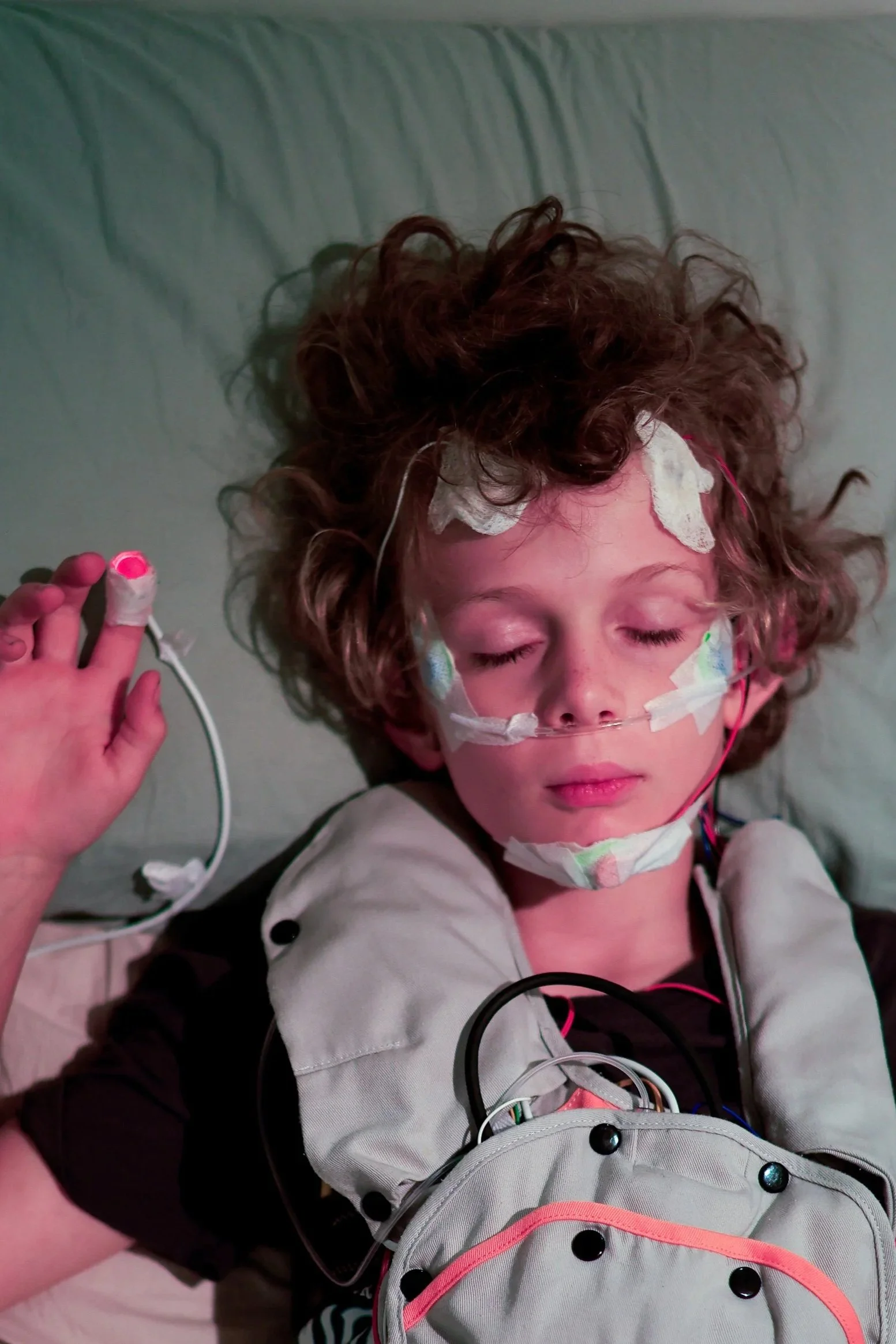
Home level 2 sleep study (polysomnogram)
Level 2 home sleep study at Prana Sleep
A Level 2 study is the service we provide at Prana Sleep. Your child comes into our clinic in the late afternoon or early evening, where one of our paediatric sleep scientists carefully fits all of the stickers. We take the time to make the setup feel calm and unhurried, there are no needles, nothing painful, and parents are with their child the whole time.
Once the equipment is on, you head home, and your child goes to sleep in their own bed, in their own room, with their own bedtime routine. The recording runs overnight on a small portable device, and the data is downloaded the following morning when you return the equipment to our clinic.
The advantage of a Level 2 study, particularly for children, is that sleep at home looks more like real sleep. Children often settle faster and sleep longer when they are in familiar surroundings with their parents nearby. For many families, avoiding an overnight hospital admission also means less disruption for siblings, less time off work, and far less anxiety in the lead-up to the study.
A Level 2 study at Prana provides the same diagnostic information as a Level 1 study for the vast majority of paediatric referrals, including suspected OSA, snoring, restless sleep, and bedwetting associated with disordered breathing. The main point of difference is that it does not measure carbon-dioxide (CO2) or video and that the study is un-attended.
Level 1 sleep study - at the Melbourne Children's Sleep Centre, Monash Children's Hospital
A Level 1 study is performed in a dedicated paediatric sleep laboratory. For our patients, this is conducted at the Melbourne Children's Sleep Centre at Monash Children's Hospital. The setup is the same as a Level 2 study, but with two important additions:
Continuous CO₂ monitoring (transcutaneous)
Synchronised video recording
A sleep scientist remains in the lab throughout the night. Level 1 studies are recommended when we need information that a Level 2 study cannot provide. Common reasons include:
Suspected hypoventilation (e.g. in children with neuromuscular conditions, complex congenital syndromes, significant obesity, or chest wall abnormalities), where CO₂ data is essential
Unusual nocturnal events, such as suspected seizures, parasomnias, or unexplained movements that need to be seen on video
Very young infants or children with significant medical complexity who require closer monitoring
Titration studies for CPAP, BiPAP, or supplemental oxygen
Which one is right for my child?
For most children referred with snoring or suspected OSA, a Level 2 study at home is an excellent first-line investigation - it is comfortable, accurate, and minimally disruptive. A Level 1 study at Monash Children's becomes the right choice when CO₂ monitoring or video is clinically necessary, or when a child's medical complexity calls for close in-person supervision.
If you are unsure which pathway your child needs, that is exactly the kind of question we are here to help you answer. Get in touch with our team at Prana Sleep and we can talk through the referral, your child's symptoms, and the most appropriate next step.