What’s the Difference between a Sleep Paediatrician and a Sleep Practitioner?
If your child is struggling with sleep, you may come across different types of professionals offering help — including sleep practitioners, sleep doctors and paediatricians.
It can be confusing to know who does what, and more importantly, who your child actually needs.
Let’s break it down simply.
👩⚕️ What is a Sleep Doctor?
A Sleep Physician, Sleep Doctor or Sleep Paediatrician is a medically trained specialist who diagnoses and treats sleep disorders in children and adolescents.
In children, this is often a paediatrician with sub-specialist training and sleep fellowships.
Paediatric respiratory & sleep physician
Paediatrician with a fellowship in sleep medicine
What they can do:
Diagnose medical sleep conditions like:
Obstructive sleep apnoea (OSA)
Obesity hypoventilation syndrome
Restless sleep disorders
Periodic limb movement disorders
Narcolepsy
Circadian rhythm disorders
Complex sleep disorders
Complex parasomnias
Insomnia
Sleep issues in neurodivergence
Order and interpret sleep studies (polysomnography or oximetry)
Prescribe medications if needed
Assess underlying medical causes (e.g. airway issues, asthma, allergic rhinitis, reflux disease, enlarged tonsils, iron deficiency)
Coordinate care with GPs, general paediatricians, ENT surgeons, paediatric dentist and orthodontists, sleep psychologists, myofunctional therapists and other specialists
In short: They look for the “why” and the “root cause” behind your child’s sleep problem.
🌙 What is a Sleep Practitioner (or Sleep Consultant)?
A sleep practitioner (often called a sleep consultant) focuses on behavioural sleep support.
They are usually:
Not medically trained doctors
Trained in sleep coaching, routines, and behavioural strategies
What they can help with:
Bedtime routines
Sleep training (especially in infants and toddlers)
Night waking and settling techniques
Sleep hygiene (environment, schedules, consistency)
In short: They help with the “how” of sleep routines and habits.
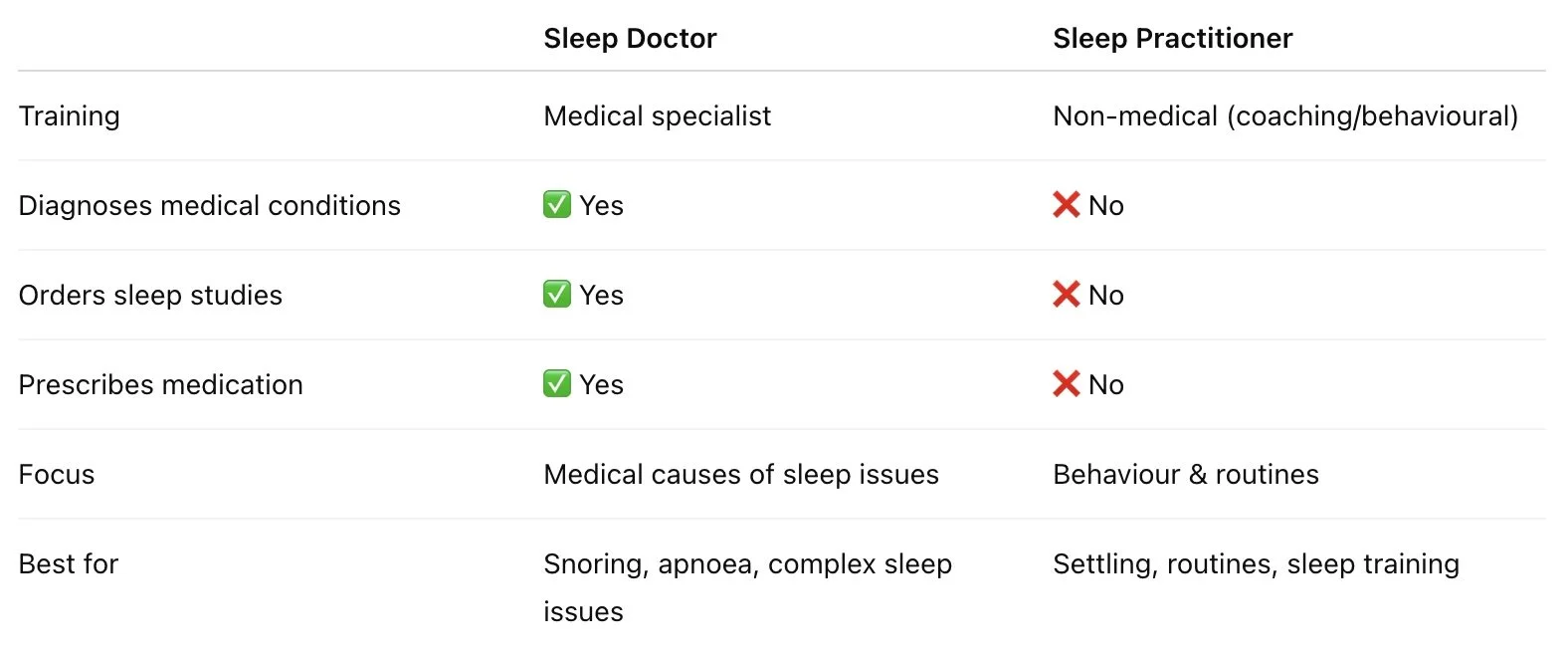
The Key Differences
When should you see a Sleep Doctor?
It’s important to see a sleep doctor first if your child has symptoms of an underlying problem that interrupts the quality of their sleep like obstructive sleep apnoea (OSA), restless sleep disorders like periodic limb movements (PLM) or restless legs syndrome (RLS). Symptoms that are red flags are:
Loud snoring or pauses in breathing
Restless or very disrupted sleep
Daytime sleepiness or falling asleep at school
Behavioural concerns linked to poor sleep like hyperactivity or inattention
Difficulty sleeping despite good routines
Medical conditions affecting sleep
These may point to an underlying medical issue, not just a behavioural one.
When is a Sleep Practitioner helpful?
Sleep practitioners are most helpful when:
Your child is otherwise healthy
The issue is mainly around sleep habits or routines
You need structured guidance for:
Bedtime refusal
Night waking
Early rising
Do they ever work together?
Yes absolutely, and this is often the best approach.
At Prana, we often:
Identify or rule out medical causes first
Then guide families on practical strategies and routines
Because the truth is, you can’t fix a medical sleep problem with sleep training alone.
Not sure where to start?
If your child has ongoing sleep concerns, especially snoring or disrupted sleep, it’s always safest to start with you GP to get a referral.