Overnight oximetry testing in children
Obstructive sleep apnoea (OSA) is one of the most common and consequential sleep disorders in childhood. Left untreated, it can contribute to behavioural problems, poor school performance, cardiovascular strain, and poor growth. Yet despite its prevalence, many children with OSA go undiagnosed due to the scarce access to gold-standard diagnostic testing: in-laboratory polysomnography (PSG). This is time-consuming, expensive, and difficult to access.
At Prana, we make at home sleep diagnostics more accessible. We perform at home sleep studies as well as overnight oximetries. Your specialist can help guide which test is required.
At Prana, we recommend overnight oximetry as a front-line screening tool for paediatric OSA. It is not a replacement for a full sleep study in every case, but for many children it provides clear, actionable answers : quickly, comfortably, and at home.
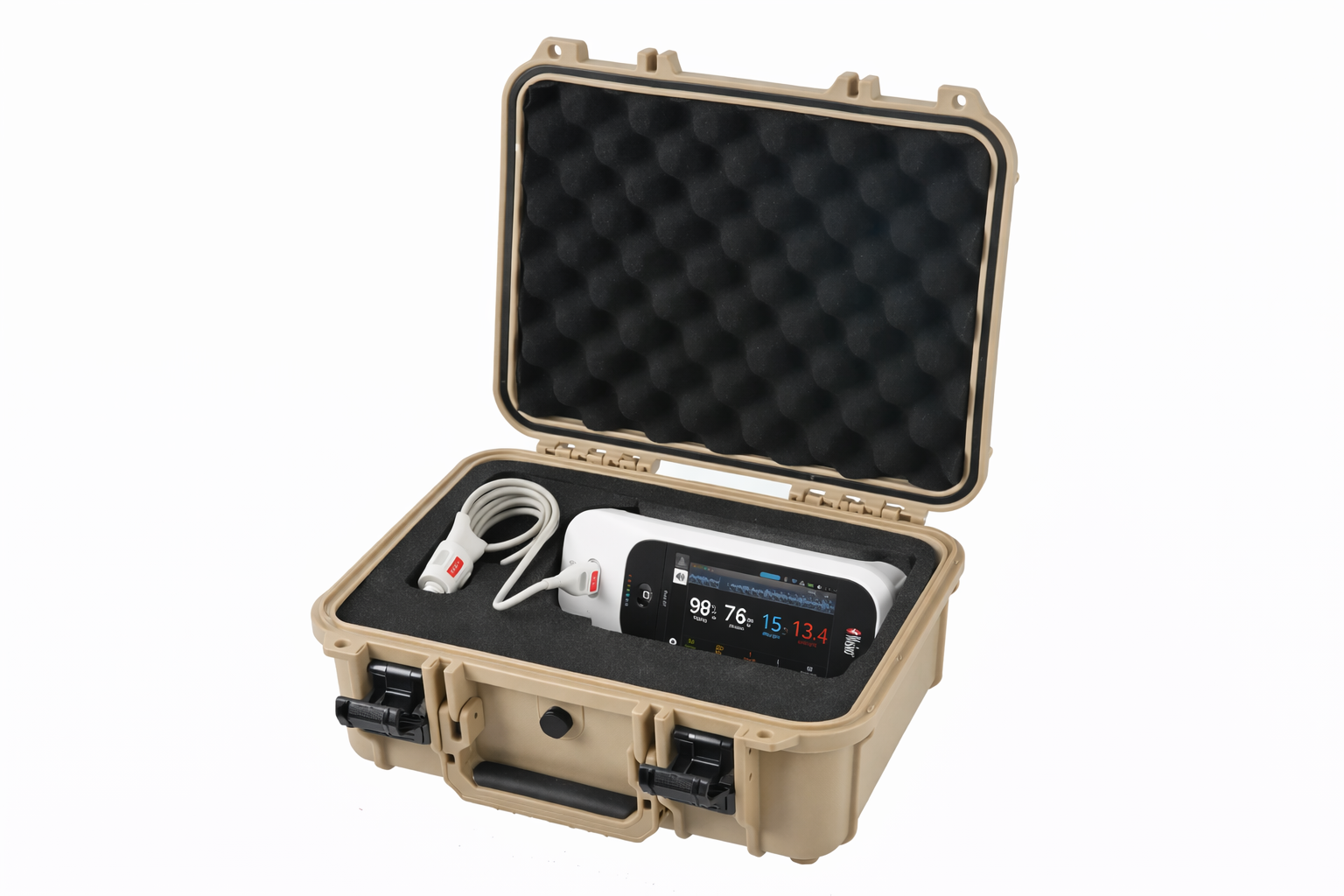
What Is Overnight Oximetry?
Overnight pulse oximetry is a simple, non-invasive test that continuously measures a child's blood oxygen saturation (SpO2) and heart rate throughout the night. It works using a small sensor, typically a wrap like a band-aid placed on the child's finger or toe. The device records data overnight quietly and produces a trend graph that a sleep physician can review the following day.
That's it. There are no wires attached to the face, no electrodes on the scalp, no technician in the room, and no requirement to spend the night in a hospital or sleep laboratory. The test can be performed entirely at home, in the child's own bed, in their normal sleep environment.
Why OSA Causes Oxygen Desaturations
To understand why oximetry is so useful, it helps to understand what happens during an obstructive event. When the upper airway partially or completely collapses during sleep, airflow is obstructed. Carbon dioxide builds up and oxygen levels in the blood fall. The brain eventually detects this and triggers a brief arousal to re-open the airway, often without the child or parent being aware. This cycle can repeat dozens or even hundreds of times per night.
Each episode of obstruction produces a characteristic dip in oxygen saturation. In children with significant OSA, these dips tend to occur in recognisable clusters … repeated episodes grouped together over short periods of time. It is these clusters that form the basis of oximetry interpretation.
The McGill Oximetry Score
The most widely used framework for interpreting overnight oximetry in children is the McGill Oximetry Score, developed by Nixon, Brouillette and colleagues at McGill University.
In their landmark 2004 paper published in Pediatrics, "Planning Adenotonsillectomy in Children With Obstructive Sleep Apnea: The Role of Overnight Oximetry" (Nixon GM, Kermack AS, Davis GM, Manoukian JJ, Brown KA, Brouillette RT), the authors showed that overnight pulse oximetry could accurately estimate the severity of OSA in children and provide clinically meaningful guidance for surgical planning.
This scoring system does more than confirm or exclude a diagnosis: it helps clinicians and surgeons prioritise treatment urgency, plan perioperative care, and counsel families about risk.
The Evidence: A Remarkably High Positive Predictive Value
The power of overnight oximetry as a screening tool lies in what happens when the test is positive. Multiple studies have now confirmed that an abnormal oximetry result in a child is a highly reliable indicator that significant OSA is present.
The foundational work in this area was published by Brouillette and colleagues, which established that three or more clusters of desaturation on an overnight oximetry trend graph carry a positive predictive value (PPV) of 97% for detecting moderate to severe OSA when compared to full polysomnography. This finding has since been replicated and built upon extensively.
Nixon and colleagues' 2004 Pediatrics paper extended this work by applying the McGill Oximetry Score to a larger cohort. Their analysis found that among children referred for evaluation of OSA who had no major comorbidities beyond adenotonsillar hypertrophy, an abnormal oximetry result had a positive predictive value of 100%. Across the full study population including children with other medical conditions, the PPV remained at 97%.
The Australian Sleep Association's technical guideline for paediatric oximetry interpretation similarly notes that in children with adenotonsillar hypertrophy and no confounding comorbidities, a positive McGill Oximetry Score carries a 98% positive predictive value for the presence of OSA.
In plain terms: when an overnight oximetry study in a child is clearly abnormal, the clinician can be highly confident that OSA is present. For a straightforward case: a previously well child snoring heavily with enlarged tonsils and adenoids — a positive oximetry result may be all that is needed to proceed directly to surgical treatment.
An Important Caveat: A normal study does not mean there isn’t OSA…
It is important to be transparent about what oximetry cannot do. Its sensitivity, the ability to detect all cases of OSA is poor. This means that a significant proportion of children with OSA will have a normal or inconclusive oximetry result. A negative oximetry study does not rule out OSA.
This is why we describe oximetry as a screening tool rather than a definitive diagnostic test for all children. When the result is clearly abnormal, it is highly reliable. When the result is normal or inconclusive, further investigation with polysomnography is warranted, particularly if the clinical history remains strongly suggestive.
For children with complex comorbidities including Down syndrome, neuromuscular disorders, craniofacial differences, or chronic lung disease, the interpretation of oximetry is more nuanced, and full sleep studies are more often necessary from the outset.
Oximetry vs. Polysomnography: A Very Different Experience for Families
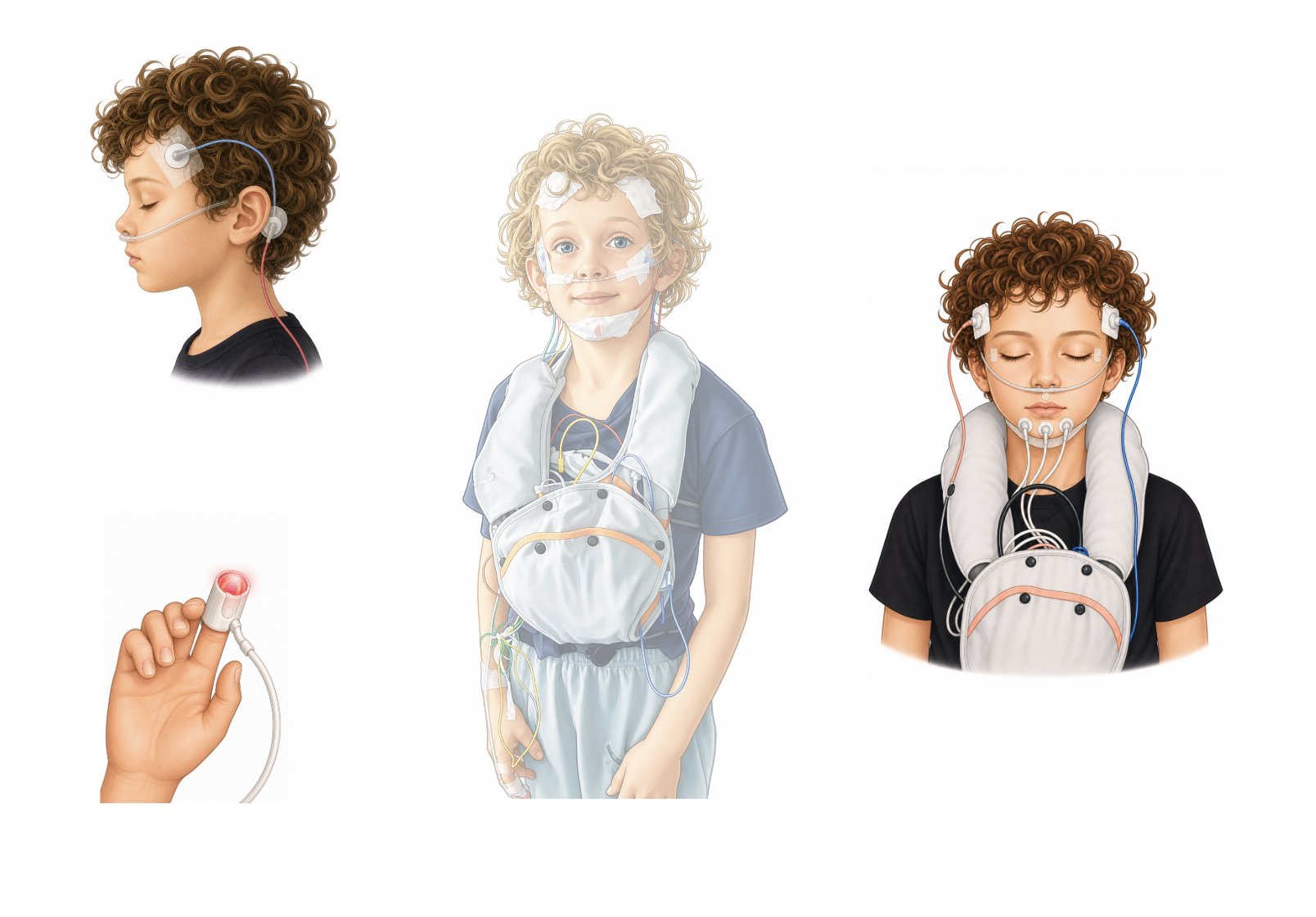
Full home sleep study
Understanding why oximetry has become such an important part of paediatric sleep medicine requires appreciating just how involved a full sleep study (polysomnography) is in comparison
A standard polysomnography study involves:
Application of up to about 15 sensors, including head electrodes, facial electrodes, respiratory belts around the chest and abdomen, leg electrodes, nasal airflow sensors, and a pulse oximeter
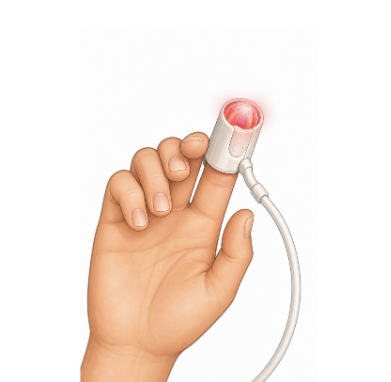
Overnight oximetry, by contrast, involves:
A single small sensor on one finger or toe
No technician present - the child's parent simply places the sensor before the child falls asleep
A compact recording device that stores data overnight
Substantially lower cost
Research has confirmed that home oximetry services significantly reduce the time from clinical referral to treatment.
How We Use Oximetry at Prana
At Prana, we incorporate overnight oximetry into a structured clinical pathway for children suspected of having OSA. After a thorough clinical assessment, including a detailed sleep history, review of relevant medical history, and where appropriate, a clinical examination - we determine whether home oximetry is a suitable first investigation or if the child is likely to be a good candidate for home level 2 sleep study.
For children who are otherwise well, with a history and examination consistent with upper airway obstruction due to adenotonsillar hypertrophy, a home oximetry study is our standard first step. If the result is clearly positive, we can provide a confident, evidence-based diagnosis and work with the child's GP and ENT surgeon to facilitate timely treatment.
If the result is inconclusive or normal but clinical suspicion remains high, we proceed to a more detailed sleep study. This stepwise approach means families avoid unnecessary complexity when a simpler test can answer the question, while ensuring that children who need further evaluation receive it.
Summary
Overnight oximetry is not a perfect test, but it is a powerful one.
When positive, it is among the most specific non-invasive screening tools available in paediatric sleep medicine : with a positive predictive value of 97–100% in otherwise healthy children, as established by Nixon and colleagues and confirmed in subsequent research. It is well tolerated, can be performed at home, requires minimal preparation, and can meaningfully shorten the time to diagnosis and treatment.
For children with suspected OSA, it offers families something that is increasingly rare in the diagnostic journey: a quick, clear, and comfortable answer.
If you are concerned that your child may have obstructive sleep apnoea, please speak with your GP about a referral to a paediatric sleep specialist. Prana Sleep provides home oximetry services and comprehensive paediatric sleep assessments.
Key References
Nixon GM, Kermack AS, Davis GM, Manoukian JJ, Brown KA, Brouillette RT. Planning adenotonsillectomy in children with obstructive sleep apnea: the role of overnight oximetry. Pediatrics. 2004;113(1 Pt 1):e19–25.
Brouillette RT, Morielli A, Leimanis A, Waters KA, Luciano R, Ducharme FM. Nocturnal pulse oximetry as an abbreviated testing modality for pediatric obstructive sleep apnea. Pediatrics. 2000;105(2):405–412.
Australian Sleep Association. Overnight Oximetry for Evaluating Paediatric Obstructive Sleep Apnoea: Technical Specifications and Interpretation Guidelines. 2019.
Trucco F, Rosenthal M, Bush A, Tan HL. The McGill score as a screening test for obstructive sleep disordered breathing in children with co-morbidities. Sleep Medicine. 2020;68:173–176.